TypeScript + WGSLMLI
tensorforge-webgpu
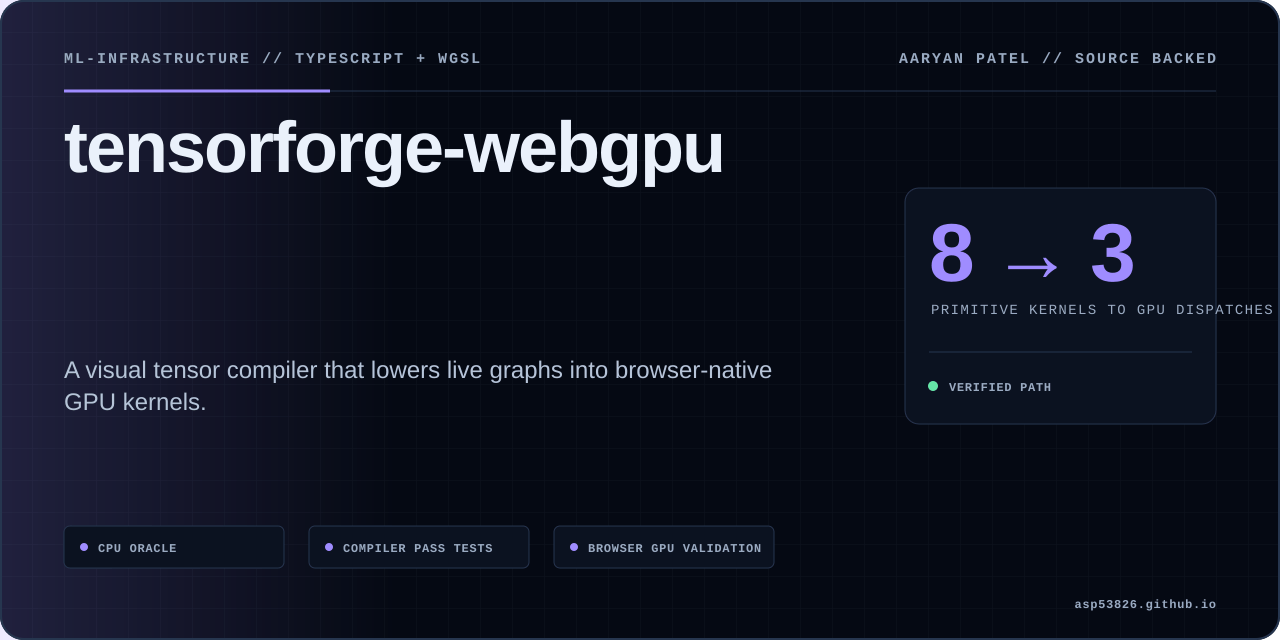
A visual tensor compiler that lowers live graphs into browser-native GPU kernels.
9 tests; the default graph lowers from 13 to 8 nodes and the live GPU result is checked against a seeded CPU oracle.
Evidence chain
The claim, with its attack surface exposed.
Recruiters can scan the result. Engineers can inspect how it was produced and where it stops being valid.
- Problem
Compiler and GPU portfolio work is difficult to evaluate when the optimization pipeline is hidden behind build logs or requires a local toolchain.
- Mechanism
Typed tensor IR, shape inference, identity canonicalization, operator fusion, output-rooted dead-code elimination, liveness-aware buffer reuse, and three generated WebGPU compute kernels.
- Attack
Deterministic CPU/GPU comparison, incompatible-shape rejection, persistent-slot isolation, fusion toggles, memory-plan tests, and responsive browser QA.
- Boundary
A narrow dense-f32 MLP experiment: kernels favor readability over autotuning, softmax is not a parallel reduction, and timing is hardware-local queue wall time.
Reproduce it
One command to the test boundary.
The repository contains the implementation, tests, benchmark harness, and documented limitations behind this page.
git clone https://github.com/asp53826/tensorforge-webgpu && cd tensorforge-webgpu && npm ci && npm run check